Remember Eternity
Menu
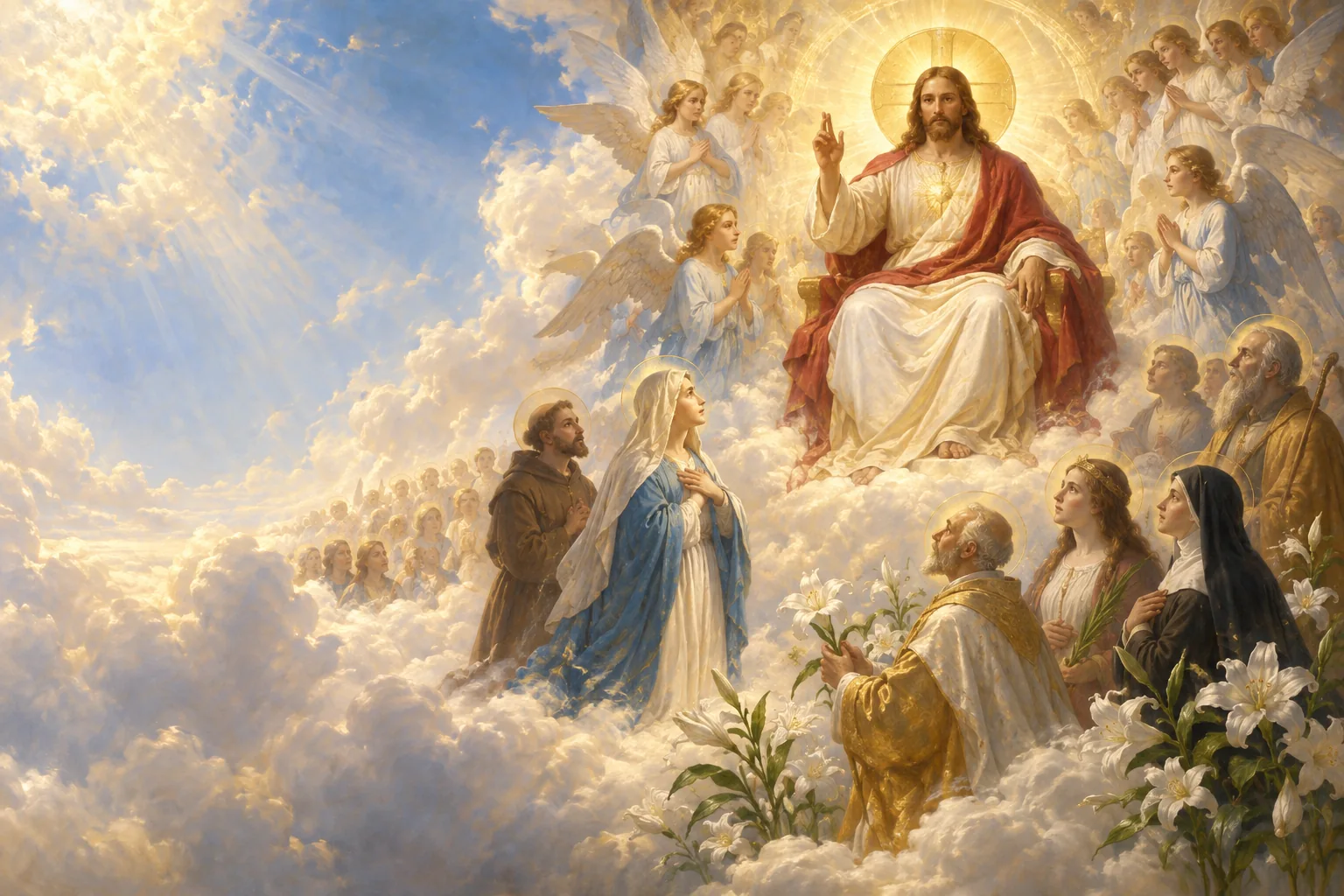
Christ in glory, surrounded by angels and saints in golden light.

Heaven

God Himself.
Seen and loved for ever.

Heaven is the possession of God: to see Him face to face, to love Him perfectly, and to rejoice for ever with Christ, Our Lady, and all the saints. Live now for this eternal happiness.

“because we shall see him as he is.”
1 John 3:2 · excerptDouay-Rheims, Challoner revision; DRBO transcription

The vision and love of God

The blessed see God as He is. Aquinas locates perfect happiness in this immediate vision of the divine essence: the mind reaches the Truth from which every created truth comes, and the heart possesses the Good it was made to seek. Its greatest gift is God Himself, Father, Son, and Holy Ghost. (Summa I–II, q. 3, a. 8.)

No creature can attain this vision by its natural powers. God raises the intellect by the light of glory, giving a share in His own blessed life without making us cease to be creatures. Jesus Christ has opened Heaven through His saving Passion. Those who die in grace and are wholly purified enjoy this vision even before the resurrection of their bodies. (Summa I, q. 12, articles 4–5; Benedict XII, Benedictus Deus.)

The blessed enjoy the vision of God without interruption or end. Their joy is secure, and their love of God will never cease. St. Augustine describes a life in which God fulfills every holy desire and the blessed delight in Him without weariness. Desire this everlasting happiness, and seek the grace to love Him faithfully now. (Benedict XII, Benedictus Deus; City of God XXII.30.)

Christian hope includes the resurrection of the body. St. Paul teaches that the dead will rise incorruptible: what is sown in weakness will be raised in power, and mortality will put on immortality. The redemption of Christ embraces the whole person. (1 Corinthians 15:42–53.)

Follow the sources

To see and love God

St. Alphonsus de Liguori
Preparation for Death

Open quiet reading

Alphonsus raises our desire to God Himself, the supreme good of Heaven. Consider the joy of never losing Him, of loving Him without sin, and of seeing Him face to face. Ask for the grace to prefer this eternal happiness to every passing pleasure.

When the soul shall have once entered into the happy kingdom of God, there shall be nothing to molest her. “Nihil est quod nolit.” “God shall wipe away all tears from their eyes; and death shall be no more, nor mourning, nor crying, nor sorrow shall be any more; for the former things are passed away. And he that sat on the throne said: Behold, I make all things new”—Apoc., xxi. 4, 5. In Heaven there is no infirmity, no poverty, no distress; there are no longer the vicissitudes of days and nights, nor of cold and heat; but a perpetual day always serene, an eternal spring always delightful. There are no persecutions, no envy. In that kingdom of love, all love each other tenderly, and each rejoices in the good of the others as if it were his own. There are no fears; because the soul, being confirmed in grace, can no longer sin, nor lose her God. “Behold, I make all things new.” Every thing is new; every thing gives consolation and content. “Totum est quod velit.”

…

But the joys we have been hitherto considering, are the least of the blessings of Heaven. The good which constitutes Heaven is God himself, the sovereign good. “Totum quod expectamus,” says St. Augustine, “duae syllabae sunt—Deus.” The reward which God promises us, is not merely the beauty, the harmony, and the other joys of this blessed city; the chief reward is God himself,—that is, to see and love God face to face. “I am thy reward exceeding great”—Gen., xv. 1.

…

What sweetness does not a soul experience when, by a ray of light, God unfolds to her in prayer his goodness, the mercies he has shown her, and the love which Jesus Christ has borne, and still bears, to her! In such moments, the soul melts and faints away through love. Yet in this life we do not see God as he is: we see him only in the dark. “We now see through a glass in a dark manner, but then face to face”—I. Cor., xiii. 12. At present there is a veil before our eyes, and God is seen only with the eyes of faith; but what shall be our joy when the veil shall be removed, and we shall see God face to face? We shall then see the infinite beauty of God, his infinite greatness, his justice, his perfection, his amiableness, and his infinite love for us.

Read the source & edition details

Consideration XXIX, Second Point, pp. 354–357 · selected passages. Dublin: James Duffy, 1843. Translated by A Catholic Clergyman (as credited on the title page). Selected historical passages, not a complete chapter. Wording and spelling follow the 1843 printing; line breaks, quotation marks, spacing, and typographic ligatures are normalized. Ellipses mark omitted material. Scripture references and secondary attributions are retained as printed; the latter are Alphonsus’s attributions. The short reading title and introduction are editorial.

Open the historical source

Act of Hope

O my God! relying on Thy almighty power and infinite goodness and promises, I hope to obtain pardon of my sins, the help of Thy grace, and life everlasting, through the merits of Jesus Christ, my Lord and Redeemer.

Baltimore Catechism No. 4, Prayers, “An Act of Hope” · historical English form

Live now for eternal happiness

Ask for the grace to prefer God to every passing good. Reject mortal sin, resist deliberate venial sin, receive the sacraments worthily, and persevere in prayer. Carry the daily cross of your duties and love your neighbor for God's sake.

Pray the Act of Charity
  1. Pray the Acts of Faith, Hope, and Charity, and ask for final perseverance.

  2. Receive the sacraments worthily; make time for adoration and quiet prayer.

  3. Resist a deliberate sin and carry today’s duties for love of God.

  4. Serve someone in need, rejoice in another’s good, and pray for the departed.

Further counsel on heaven

The joy of belonging wholly to God.

Hope for Heaven commits us to holiness now. Renounce mortal sin, resist deliberate venial sin, receive the sacraments with proper preparation, and carry the daily cross in union with Christ. Alphonsus joins perseverance to prayer and the means of avoiding sin. The desire to see God should teach us to prefer His will to a passing pleasure. (Preparation for Death, XXXI; Matthew 16:24.)

Practice the charity that will endure in Heaven. St. Augustine describes the blessed living in peace without envy, content with the gifts God has given them. Begin that freedom now: give thanks for another’s good, forgive injuries, and serve your neighbor for God’s sake. Ask Our Lady and the saints to help you love Christ more faithfully. (City of God XXII.30; Preparation for Death, XXXII–XXXIII.)

St. Augustine describes the eternal Sabbath as rest filled with the vision, love, and praise of God. The blessed have no weariness, want, or fear of losing their joy. Set aside time for adoration and quiet prayer, allowing the promised end to order your desires. Ask for growth in charity and the grace to persevere until that promise is fulfilled. (City of God XXII.30; Summa I–II, q. 114, a. 9.)

Read more deeply.